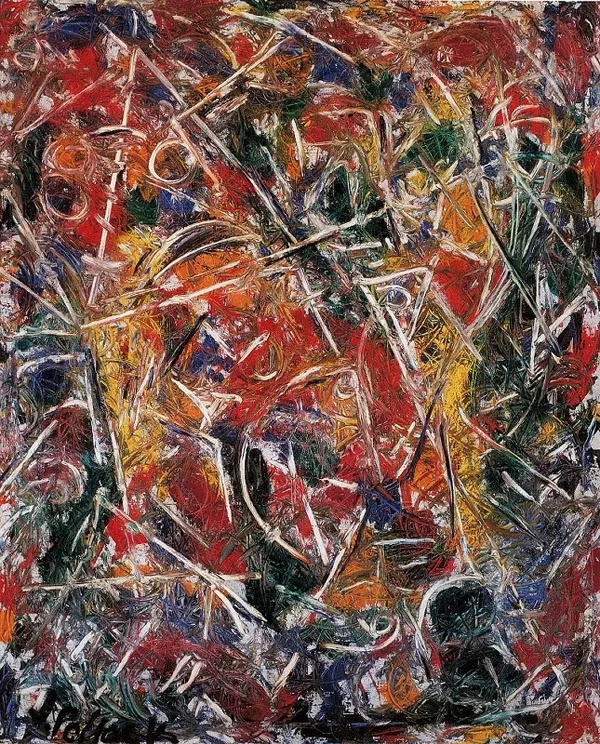
Jackson Pollock (born January 28, 1912, Cody, Wyoming, U.S.—died August 11, 1956, East Hampton, New York) was an American painter who was a leading exponent of Abstract Expressionism, an art movement characterized by the free-associative gestures in paint often called “action painting.” During his lifetime he received widespread publicity and serious recognition for the radical poured, or “drip,” technique he used to create his major works. Among his contemporaries, he was respected for his deeply personal and totally uncompromising commitment to the art of painting. His work and example had enormous influence on them and on many subsequent art movements in the United States. He is also one of the first American painters to be recognized during his lifetime and after as a peer of 20th-century European masters of modern art.
Paul Jackson Pollock was the fifth and youngest son of Stella May McClure and LeRoy Pollock, who were both born and raised in Iowa and of Scotch-Irish extraction. LeRoy’s original surname was McCoy before his adoption about 1890 by a family named Pollock. The family left Cody, Wyoming, 11 months after Jackson Pollock’s birth; he would know Cody only through family photographs. Over the next 16 years his family lived in California and Arizona, eventually moving nine times. In 1928 they moved to Los Angeles, where Pollock enrolled at Manual Arts High School. There he came under the influence of Frederick John de St. Vrain Schwankovsky, a painter and illustrator who was also a member of the Theosophical Society, a sect that promoted metaphysical and occult spirituality. Schwankovsky gave Pollock some rudimentary training in drawing and painting, introduced him to advanced currents of European modern art, and encouraged his interest in theosophical literature. At this time Pollock, who had been raised an agnostic, also attended the camp meetings of the former messiah of the theosophists, Jiddu Krishnamurti, a personal friend of Schwankovsky. These spiritual explorations prepared him to embrace the theories of the Swiss psychologist Carl Jung and the exploration of unconscious imagery in his paintings in subsequent years.
In the fall of 1930 Pollock followed his brother Charles, who left home to study art in 1922, to New York City, where he enrolled at the Art Students League under his brother’s teacher, the regionalist painter Thomas Hart Benton. About this time Jackson dropped his first name, Paul. He studied life drawing, painting, and composition with Benton for the next two and one-half years, leaving the league in the early months of 1933. For the next two years Pollock lived in poverty, first with Charles and, by the fall of 1934, with his brother Sanford and his wife in Greenwich Village.
Pollock was employed by the WPA Federal Art Project in the fall of 1935 as an easel painter. This position gave him economic security during the remaining years of the Great Depression as well as an opportunity to develop his art. From his years with Benton through 1938, Pollock’s work was strongly influenced by the compositional methods and regionalist subject matter of his teacher and by the poetically expressionist vision of the American painter Albert Pinkham Ryder. It consisted mostly of small landscapes and figurative scenes such as Going West (1934–35), in which Pollock utilized motifs derived from photographs of his birthplace at Cody.
In 1937 Pollock began psychiatric treatment for alcoholism, and he suffered a mental health crisis in 1938, which caused him to be hospitalized for about four months. After these experiences, his work became semiabstract and showed the assimilation of motifs from the modern Spanish artists Pablo Picasso and Joan Miró, as well as the Mexican muralist José Clemente Orozco. Jungian symbolism and the Surrealist exploration of the unconscious also influenced his works of this period; indeed, from 1939 through 1941 he was in treatment with two successive Jungian psychoanalysts who used Pollock’s own drawings in the therapy sessions. Characteristic paintings from this period include Bird (c. 1941), Male and Female (c. 1942), and Guardians of the Secret (1943).







.jpeg)


.jpeg)


.jpeg)
.jpeg)